FIRST INK!
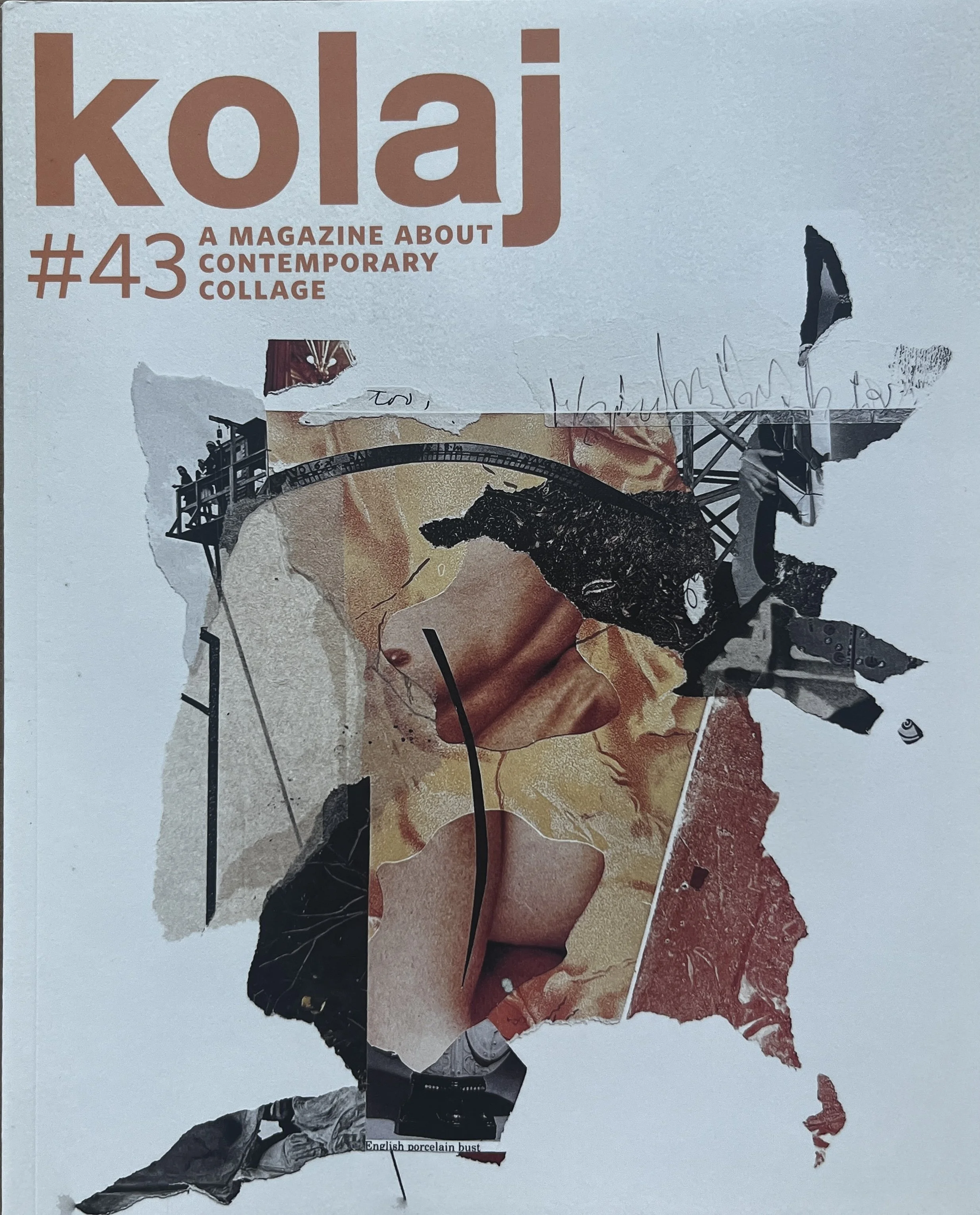
I sent my “Penny Colossus” post to the editors of KOLAJ Magazine, among others, and they were sufficiently intrigued to look at the rest of my website. That scrutiny resulted in the first print coverage of my visual art, in issue #43, now available. KOLAJ is a print-only quarterly, bless their analog hearts: no website to link to, only the ad-free magazine to purchase — become a subscriber! Meanwhile, I offer these blue-ish phone photos. All of these artworks appear elsewhere on the site — in their real colors.
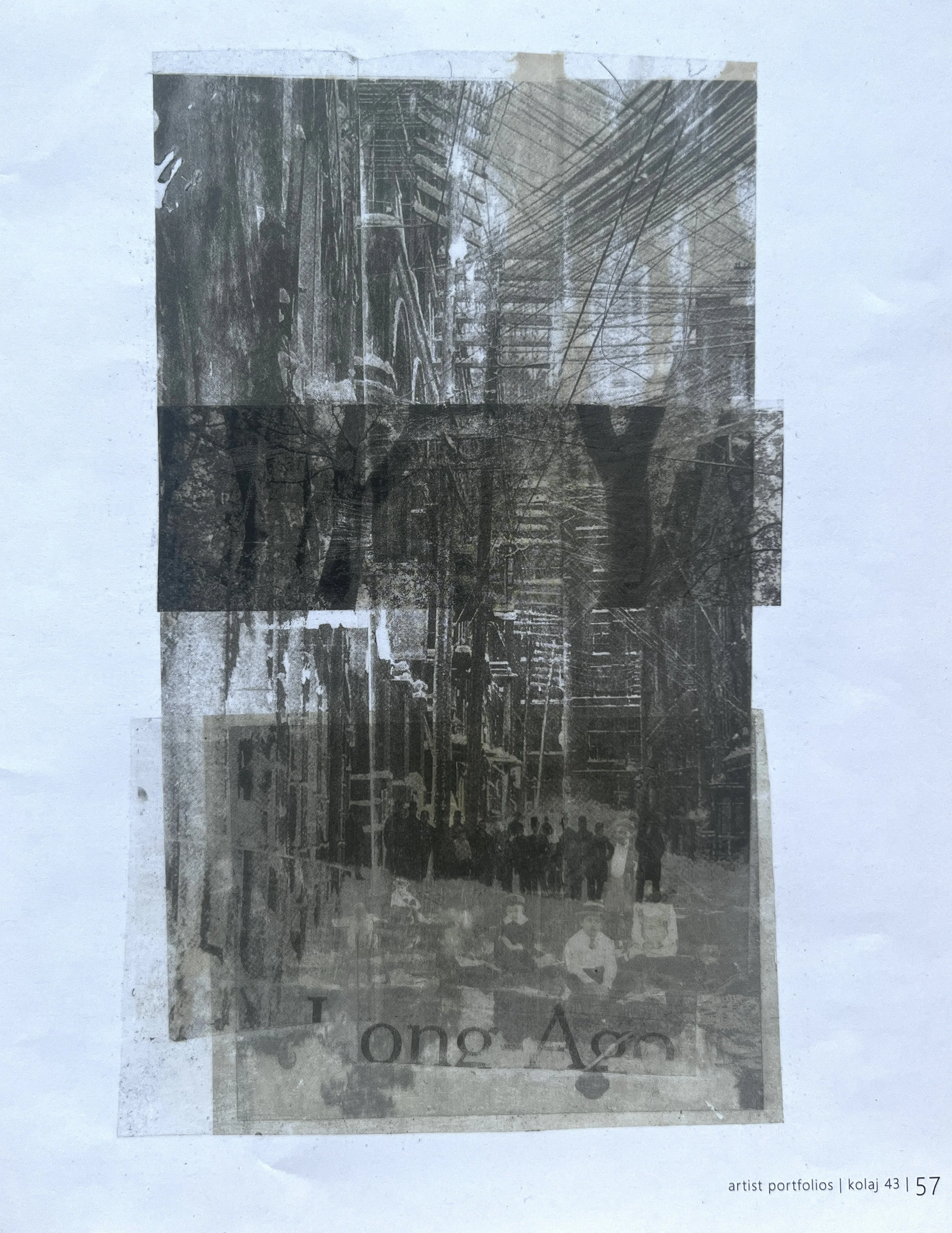
The editors decided to write about my layered transparencies, work that I made between 2008 and 2012. I like to try new techniques and late one evening came across instructions for making transparencies that required only clear tape, tap water, and a spoon. I grabbed a roll of packing tape and made my way to the kitchen. For the next few years my Formica cabinets became a staging area. Dozens of transfers arrayed the surfaces and I’d stick them to one another, make more, trying to get something to happen. I transferred only black & white images without thought as to how they might combine. But combine they did. I made a lot of them and sold quite a few, including two to a London investment banker on the day the stock market crashed in 2008.
I remember that at breakfast time, my young son enjoyed seeing how they had moved arund while he slept. You know, the way toys do.
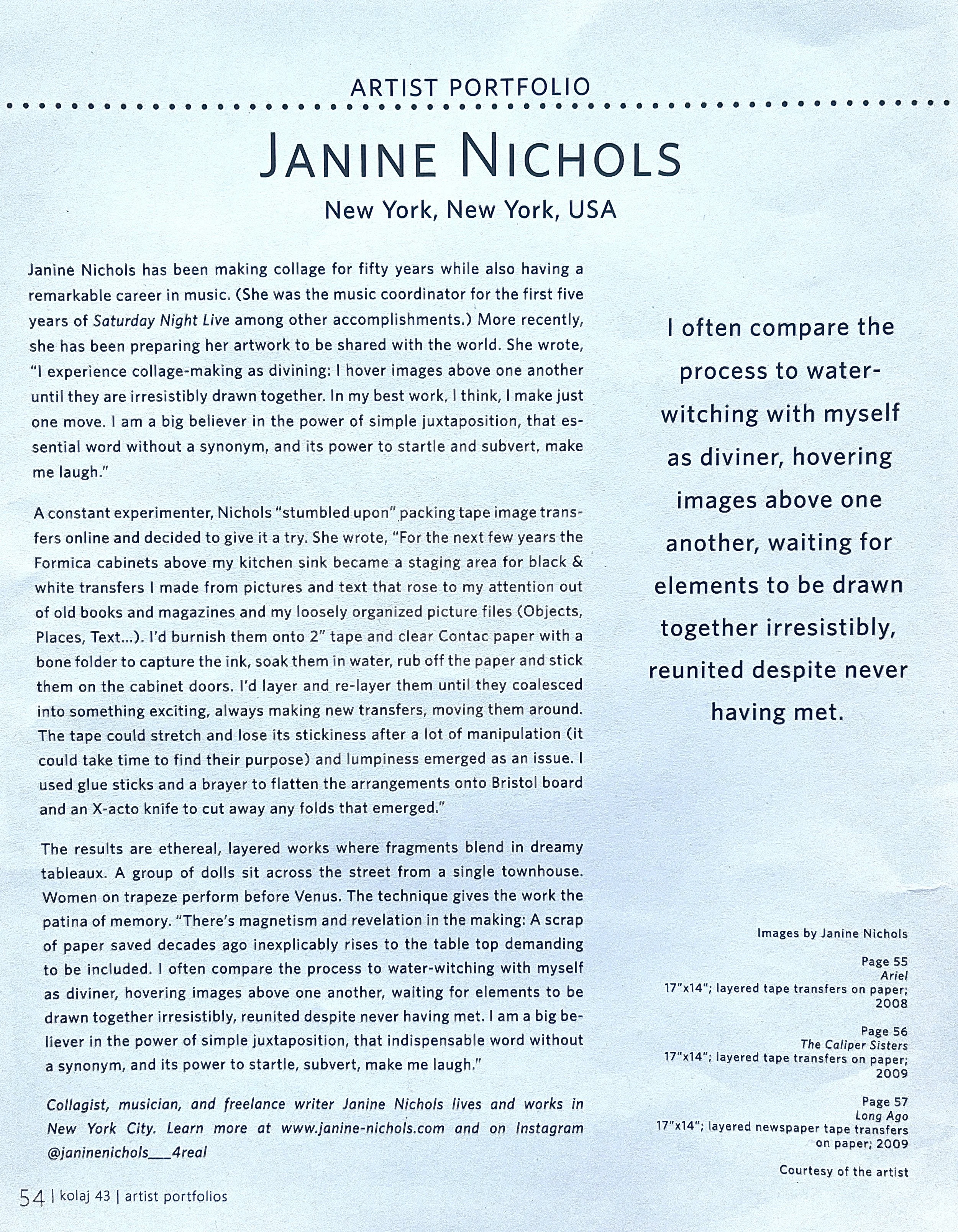
Ariel, up first, marries a 16th century Dutch engraving of the fickle goddess of Fortune (reverse) to a circus illustration. Long after her making, I gave her as a gift to my brother-in-law, whose unicorn of a daughter, Ariel, had become an actual aerialist. I’d be happy to sell you a lovely giclée print, though, not at all blue. She makes sturdy company.
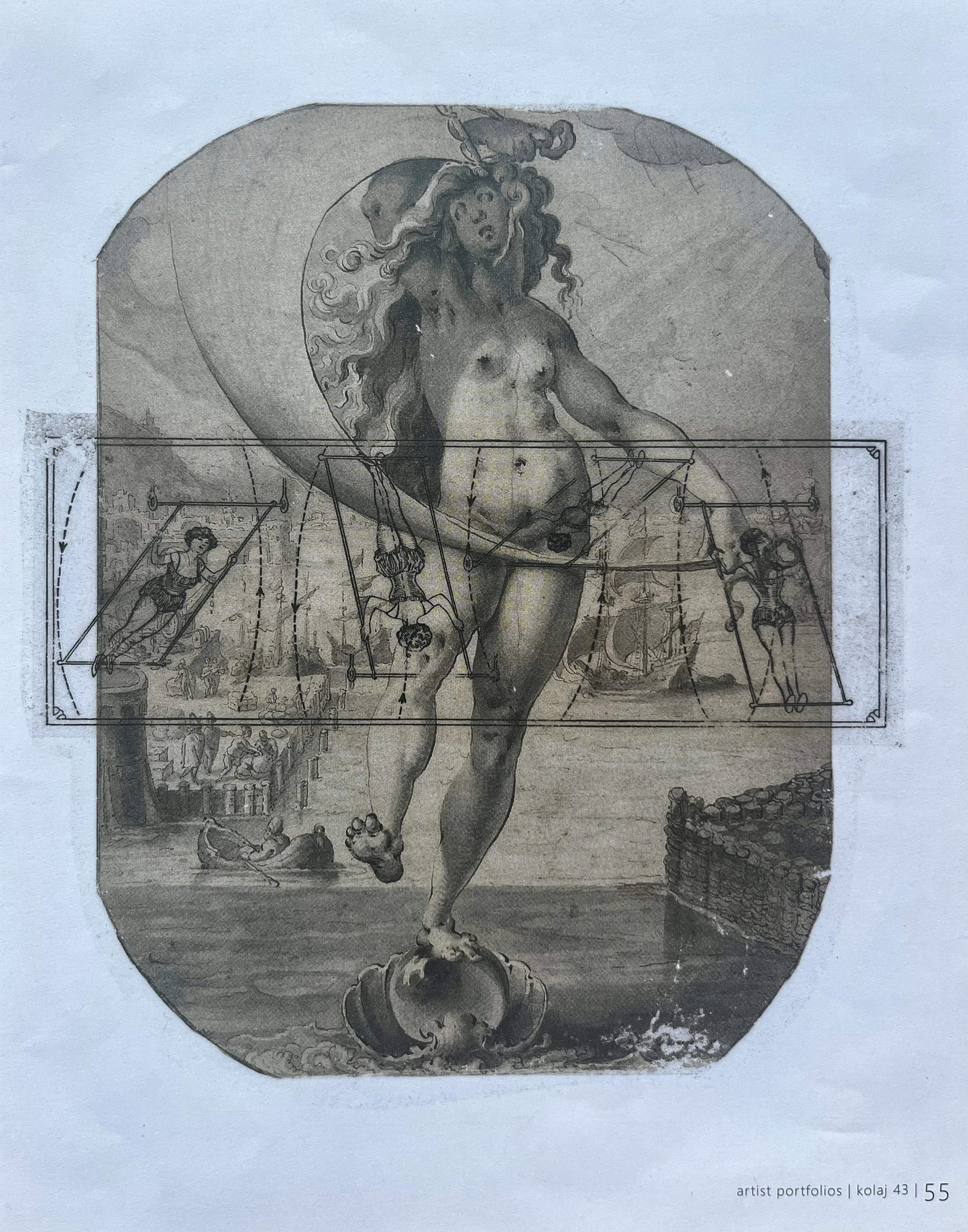
The Caliper Sisters in Danger (below) came together from the accumulation of transparencies on the cabinet faces, almost like a jigsaw puzzle. It began with a newspaper photo of one-half an abandoned building, in the Bronx, I think. Catalog illustrations of calipers suddenly became bonneted ladies of another century leaving the house for a walk. I’m pretty sure they don’t see the US Marines on their lawn but whether the army is attacking or defending I still can’t say. A moody sky moves through and across the building; inexplicably, there’s a pony in an upper storey window. Across the cornice are two lines of text: “The Lady Poverty was fair: But she has lost her looks of late.”
I see that I placed a black rectangle to the right of the house. It may be a time portal. I can’t explain any of this. Who knows how long the various elements languished on the Formica before they recognized their collective purpose.? This is what I mean when I equate collage making with water-witching. The pictures know where they belong. I’m here to wield the crooked stick.
Long Ago was composed of newspaper photos of old New York, its streets and fire escapes blanketed with snow, when the city looks its best. I wanted to clarify the foreground and overlaid these children dressed for summer onto the snowy street. The menace of electrical wires comes from somewhere else. Chicago, maybe? I visited there a few years ago and was stunned at the unnerving thatch of overhead wires in some neighborhoods. The partial headline provided the title. I have to have titles.
PENNY COLOSSUS
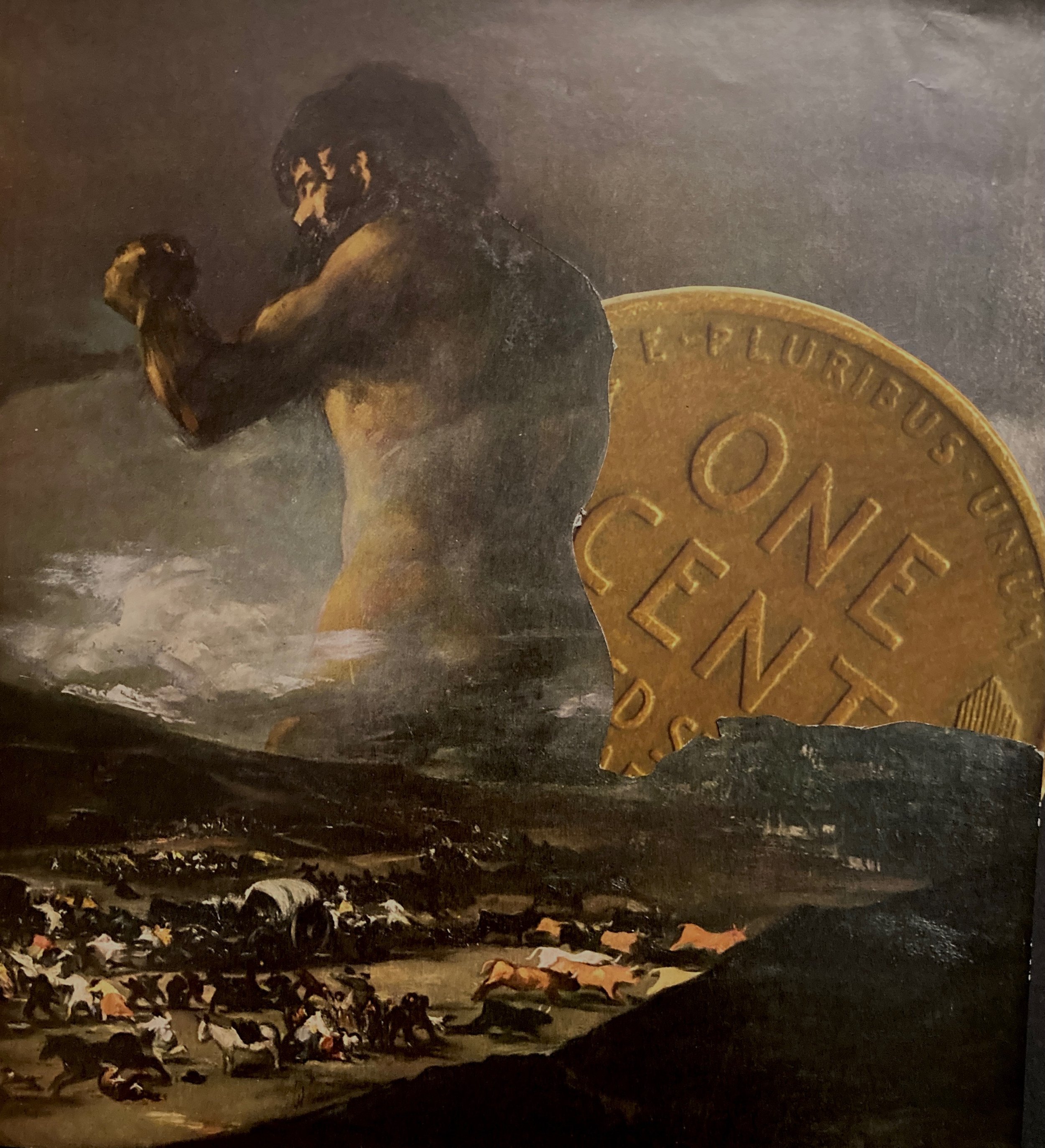
Penny Colossus (2023) Paper collage
It’s official. The penny is no more. As of Wednesday, November 12, 2025 the US Mint has ceased production of the copper penny, the cost of which exceeds its value by more than two additional pennies, said to be too wasteful, despite the fact that it costs fourteen cents to make a nickel, 6 cents to make a dime and fifteen to make a quarter. The first penny was minted in 1793 and featured a frightened-looking Liberty with tousled hair people found objectionable. In 1793, a penny would buy you a biscuit, a candle or a piece of candy. Penny candy was still a thing for post-WWII kids like me.
The National Association of Convenience Stores has long advocated for the abolition of the penny, but its sudden demise this week unaccompanied by instructions for how to carry on, came as a shock to them and all retailers. “This is not the way we wanted it to go,” said its representative. Round up? Round down? Hoard? Redeem for prizes? Some banks, paradoxicially, now are rationing pennies. Make it make sense!
I keep a jar of Wheaties for uses to be determined. I have two old typewriters with the cent sign offered in the lowercase, just below the @, a sign that rose to an unimaginable dominance. I don’t remember knowing what it was for as a kid. I still like that the cent sign always followed the number, so that 5 cents was written as pronouced, as opposed to $1.
The faces of coins tell stories about a people, a civilization. The copper penny kept President Lincoln present, he who freed the slaves. The current regime probably doesn’t want that reminder, but s demise certainly can’t be entirely attributed to wasteful spending. What’s now proposed is a silver dollar with Dear Leader’s face both obverse and reverse, reading both E PLURIBUS UNUM and FIGHT FIGHT FIGHT. Not incidentally, its production would violate federal law, which prohibits depictions of living persons on the nation’s currency for precisely the reason he wants it.
When I made this collage, simple as it appears, it took a while to properly position the penny. I chose to make the Latin phrase fully visible as an antidote to the mayhem in the foreground, the calm that follows the storm. Francisco Goya painted this fearful scene in Spain during the Peninsular War, whatever that was, between 1808 and 1812. And there are other versions. Sometimes the Giant seems forlorn, his back to the world beneath a crescent moon, but he’s aggressive in this version, and chaos reigns below, people and horses and cattle scattering in terror, blood on the ground.
I could never have imagined that one day this juxtaposition of giant and penny might be understood as prescient or profound.
The Windows shortcut for the cent sign is Alt + 0162.
Prints available. Please write me at the link in the Contact page.
THE THIRD THING

Braintree (2012) layered tape transfers on paper, 14" x 17"
Rare is the artist who can describe in a few words the power of collage. One I’ve found is Todd Bartel, who came onto my radar, and I onto his, in 2012 when he included my piece, Braintree, in the centennial he curated at the Thompson Gallery in Weston, MA. Braintree, like so much of my paper collage, is a straightforward juxtaposition, in that case an ink drawing of a bare tree by Leonardo da Vinci with an overlay of leaves made from a sectional drawing in an old anatomy book that is, truth be told, a section of the stomach (no one notices). Braintree is a town in Massachusetts, and the title might have brought the piece to his attention. I can’t help it if I’m lucky.
I was looking at Todd’s work online recently, and reading/watching his interviews. As a champion of juxtaposition, I was beyond grateful to find – somewhere -- his “practical and cherished” definition of collage:
“A collage is established by putting together two or more collected things—actual or intellectual. Anything coupled is a collage…. In a phrase, “one plus one equals three.” One thing plus another thing equals a third thing—a phenomenological, third thing. The third thing is the true nature of collage. My practical and cherished definition of collage is “the third thing.”
Elsewhere, he added that “collage is odd math” wherein “1 + 1 = 3.” Eureka. I’d been searching for a category title describing a selection of my work that meets his elemental description. I am very grateful to him for the solution. “Juxtaposition” has no artistic synonym.
Of course, Todd’s work is captivatingly complex (no one makes more poetic use of document repair tape than he), lately, vast landviews, his word, exquisitely imagined and crafted, often double-sided, slipped between glass in hinged frames. No one makes more poetic use of document repair tape than he. Follow him down.
TITUS CAVE | NICK CAVE
I liken my collage-making process to divination – not the spirit-summoning kind, but the water-dowsing kind, hovering and waiting for the sudden and irresistible movement of a forked twig toward a deep, invisible store of water.
When Titus Cave came together, I was watching a ball game on TV, scissors in hand, freeing some songbirds from reproduction postcards. Once they were liberated, I moved them over to my tabletop and started rifling through my paper files, looking for their companions, hovering them above disparate images. I had no end in mind.
Two images leapt up, though, both saved some 20 years before. One was a scrimshaw horn from National Geographic crafted by a sailor named Titus Cave in Chester, England in 1772. The other was a photograph of a chubby Black infant of a century ago, smiling in a washtub barely wider than he. Suddenly, even obviously, the curve of the horn became a boat or balloon for happy baby Titus to sail in, borne aloft by songbirds.
Laid out on newsprint, the arrangement cast a lovely shadow suggestive of flight. Thinking about how to preserve the shadow presented me with the solution to a series I’ve been working on using NASA photographs collected my broken spine copy of the book “Full Moon”, by Michael Light.
When I stepped away to check my phone, I learned that it was Nick Cave’s birthday I’ve been close with Nick since 2004, when he joined the cast of Came So Far for Beauty, the concerts of Leonard Cohen’s music that I co-produced with the late wonderful Hal Willner.
I took a screenshot of the unglued Titus Cave in progress and texted it to Nick in England, saying that I hadn’t known it was his birthday, yet look what came together tonight. He is an early riser and responded instantly, “That’s MINE!!!!!!!” And now Titus enjoys pride of place in his London home.

Titus Cave (2024), mixed media on art board, 9 x 12 (Private Collection)
I liken my collage-making process to divination – not the spirit-summoning kind, but the water-dowsing kind, hovering and waiting for the sudden and irresistible movement of a forked twig toward a deep, invisible store of water.
When Titus Cave came together, I was watching a ball game on TV, scissors in hand, freeing some songbirds from reproduction postcards. Once they were liberated, I moved them over to my tabletop and started rifling through my paper files, looking for their companions, hovering them above disparate images. I had no end in mind.
Two images leapt up, though, both saved some 20 years before. One was a scrimshaw horn from National Geographic crafted by a sailor named Titus Cave in Chester, England in 1772. The other was a photograph of a chubby Black infant of a century ago, smiling in a washtub barely wider than he. Suddenly, even obviously, the curve of the horn became a boat or balloon for happy baby Titus to sail in, borne aloft by songbirds.
Laid out on newsprint, the arrangement cast a lovely shadow suggestive of flight. Thinking about how to preserve the shadow presented me with the solution to a series I’ve been working on using NASA photographs collected my broken spine copy of the book “Full Moon”, by Michael Light.
When I stepped away to check my phone, I learned that it was Nick Cave’s birthday I’ve been close with Nick since 2004, when he joined the cast of Came So Far for Beauty, the concerts of Leonard Cohen’s music that I co-produced with the late wonderful Hal Willner.
I took a screenshot of the unglued Titus Cave in progress and texted it to Nick in England, saying that I hadn’t known it was his birthday, yet look what came together tonight. He is an early riser and responded instantly, “That’s MINE!!!!!!!” And now Titus enjoys pride of place in his London home.